

Logistic Intelligence: The Engine of Autonomous Business
Digital logistics is entering a new phase. After digitising orders, warehouses, shipments and tracking, the next step is not simply to automate more activities, but to use intelligence to make the entire logistics ecosystem work more efficiently.
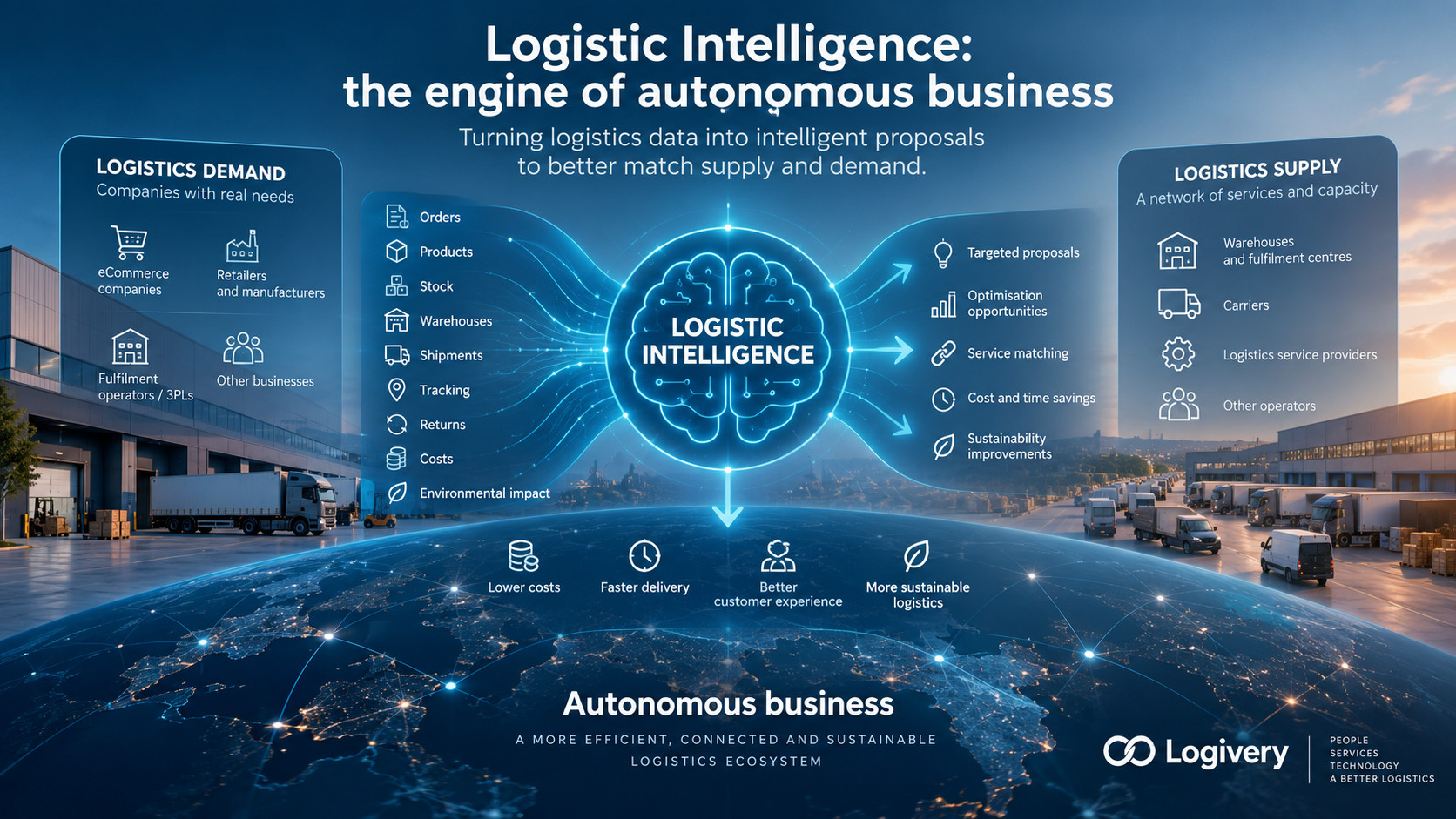
This is the idea behind Logistic Intelligence: a system capable of understanding each user's operational situation and using this information to support, in an increasingly intelligent way, the matching of logistics service supply and demand.
Logivery is designed precisely as a multi-actor platform connecting eCommerce companies, retailers, manufacturers, warehouses, fulfilment operators, 3PLs, carriers and other logistics service providers.
From searching for a service to receiving an intelligent proposal
In a traditional marketplace, users have to search for what they need: they must identify the service, compare the alternatives and choose the provider.
Logistic Intelligence can reverse this logic.
The platform knows the user's logistics context: orders, products, stock, warehouses, shipments, tracking, returns, costs and, progressively, information about environmental impact.
This allows Artificial Intelligence not only to respond to an explicit request, but also to identify a need autonomously and propose a targeted solution.
An eCommerce company experiencing rapid growth in order volumes in Germany could, for example, receive a recommendation to use a local warehouse available within the network.
A company facing high costs for certain destinations could receive a proposal to use an alternative transport service.
At the same time, a warehouse with available capacity could be matched with companies looking for storage space or fulfilment services in the same geographical area.
The marketplace therefore becomes progressively proactive.
A marketplace that understands supply and demand
Logivery does not simply publish logistics operator profiles or facilitate a basic commercial contact. Its objective is to make logistics services available, comparable, activatable and operationally manageable within the same digital ecosystem.
Logistic Intelligence adds a further layer to this infrastructure.
On one side, it can understand real demand by observing the needs that emerge from users' day-to-day operations.
On the other side, it can understand the available supply: warehouse capacity, services offered, geographical coverage, commercial conditions, performance and the characteristics of operators within the ecosystem.
Artificial Intelligence can therefore continuously identify possible matches between supply and demand.
Not simply:
“Find a warehouse in Germany.”
But rather:
“Based on your volumes, order destinations and current costs, using this warehouse could reduce fulfilment times and costs.”
That is a significant difference.
From Logistic Intelligence to autonomous business
This is where the connection with autonomous business becomes clear.
An autonomous system does not simply execute instructions. It observes the context, identifies opportunities, proposes decisions and, when authorised, can also activate the process required to implement them.
The platform could therefore identify an opportunity, estimate its costs and benefits, propose a new logistics provider and guide the user through to service activation.
People remain in control of important decisions, but they do not necessarily have to identify every single opportunity themselves.
The value grows with the ecosystem
The more companies, operators and services participate in the platform, the greater the opportunities to create useful connections.
At the same time, the more operations are managed, the richer the pool of contextualised data becomes, helping to improve future recommendations.
Logistic Intelligence can therefore become much more than an analysis or optimisation tool.
It can become the intelligent engine of the Logivery marketplace: the layer that observes what is happening across the network, understands needs and available capacity, and continuously creates new opportunities to match supply and demand.
It is precisely in this transition, from a marketplace that users consult to an ecosystem that proposes, coordinates and progressively acts, that autonomous business begins to take shape.